2026.09.23
Content
How do Extreme Climate Habitats Pods work? On a wind-scoured plateau in western Patagonia, a 12-meter prefabricated module sits 400 meters from a glacier. Afternoon temperatures reach 18°C; by 3 a.m., they fall past -12°C, and sand-laden gusts above 80 km/h hammer the shell for weeks. For the resort operator who specified it, the question is not theoretical. It is engineering: keep the interior at 22°C when the exterior swings through 30°C in 12 hours. The answer lives in three layers — a weather-sealed structural shell, a thermal insulation envelope, and active climate-management equipment. The Extreme Climate Habitats Pods series from Zhejiang Honghuiyuan Import & Export Co., Ltd. is built around exactly these three systems.
Extreme climate habitat pods work by combining three independently engineered layers into one prefabricated module. The shell handles wind, snow, UV, and driving rain. The envelope limits conductive heat transfer through every square meter of wall, floor, and roof. The active system compensates for heat generated by occupants and equipment while regulating fresh air intake. Each layer addresses a specific failure point; removing any one of them makes the whole module unsafe for its site.
The goal is not to increase heating capacity endlessly, but to prevent the exterior condition from ever reaching the interior. For a 30 m² pod with roughly 100 m² of exposed surface area, upgrading from 100 mm EPS to 120 mm polyurethane foam cuts heating demand by about 45% at a -30°C exterior. That is the difference between a 2 kW heater and a 1.1 kW heater — a scale that directly changes the size of the solar array, battery, and backup generator you install.
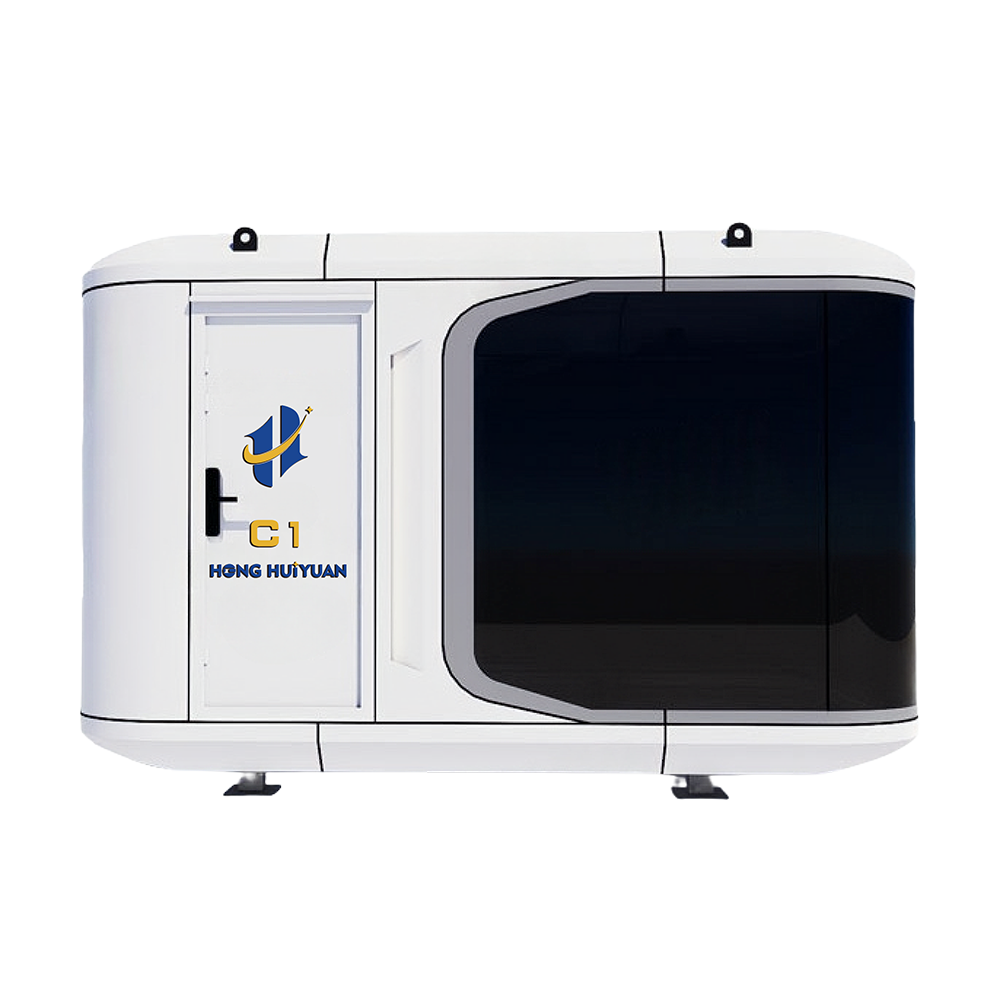 Climate-Resistant Modular Pods for Extreme EnvironmentsThese modular pods are designed to withstand harsh climates with insulated shells and corrosion-resistant coatings, reducing heating demands in cold conditions and suitable for off-grid setups.View Product →
The shell of an extreme climate habitat pod is a welded steel frame enclosed in sealed composite panels with a corrosion-resistant coating, rated to carry the full snow load of a northern winter and the wind pressure of an open ridge.
The frame consists of galvanized steel or aluminum alloy profiles welded into one rigid module. The whole pod behaves as a single component under load, rather than a series of joints and fasteners. The cladding is steel or aluminum composite paneling joined with sealed corner profiles and drip edges. This is the same sealed-shell principle that separates a space capsule house from a conventional structure.
The coating determines long-term weather tolerance. Fluorocarbon coatings reflect UV and resist fading over 10-15 years; polyurethane systems provide a quieter, sand-resistant barrier. Pods in desert or coastal sites receive a thicker two-coat application. Roof slope is kept minimal to shed snow, while providing secure attachment points for solar panels and external shading.
The active climate system uses a split heat pump to heat and cool, separates fresh-air exchange from heat loss with an energy-recovery ventilator, and filters out sand and ice crystals before they enter the interior.
A typical 25-35 m² pod carries a 3-5 kW split heat pump. In winter it draws about 1 kW of electrical power to deliver 3-4 kW of heat. This makes it a much better match for a solar-battery system than a resistive heater, which would empty a 15 kWh battery in five hours. A heat pump keeps the same period running for eleven. This is the same logic behind smart living pod features: you size the active system from the building actual load, not from a generic estimate.
The energy-recovery ventilator is the component owners often overlook. It exchanges stale interior air for fresh exterior air while keeping 80-95% of the heat or coolness on the correct side of the boundary. In a sealed pod, this continuous low-rate exchange is what keeps condensation out of the wall assembly and carbon dioxide below harmful levels.
Smart Living Pods with Energy Recovery VentilationThese pods feature continuous ventilation that recovers heat or coolness, maintaining air quality and preventing condensation, making them efficient for sealed, insulated living spaces.View Product →The insulation envelope controls most of the heat loss in a pod, so material choice — closed-cell polyurethane foam, XPS, or EPS panels — has a larger effect on performance than heater size.
Insulation performance is measured as U-value, the amount of heat passing through one square meter of wall per degree of temperature difference. A wall built with 100 mm of EPS reaches about 0.38 W/m²K. With 120 mm of polyurethane foam plus thermal breaks at the frame, it drops to roughly 0.21 W/m²K.
| Insulation layer | U-value | Best use case |
| EPS 100 mm | 0.38 W/m²K | Low-cost pods in moderate cold, controlled sites |
| XPS 100 mm | 0.33 W/m²K | Wet or freeze-thaw-prone ground conditions |
| PU 120 mm + thermal break | 0.21 W/m²K | Subzero winters, remote off-grid sites |
Required heating power for a 30 m² pod at -30°C exterior / 22°C interior
Thermal bridges are the hidden failure point. A wall with 120 mm of foam but an aluminum frame that touches both the inside and outside surfaces loses more heat through the metal than through the entire wall. Sealed panel joints, insulation around the frame, and closed-cell foam that absorbs no moisture make those numbers real.
Most extreme-climate sites sit far from utility grids, so the standard pod package integrates solar power, battery storage, a water tank, and a treatment system directly into the module.
The power package starts with a 6-10 kW photovoltaic array, an MPPT charge controller, and a 10-20 kWh lithium battery bank. Four to six clear solar hours in a high-latitude winter let this system carry a full night of heat pump and ventilation load — but only if the insulation package has already lowered that heating demand to 1.1-1.4 kW peak.
Water handling follows the same self-contained logic. A 500-2,000 L fresh water tank sits inside the pod or on the roof structure, gravity-feeds a pressurized distribution line, and supplies a tankless water heater when the solar pre-heater cannot keep up. Permanent extreme-climate installations often specify a waterless or composting toilet instead of a flush model.
The same pod model is reconfigured by changing insulation thickness, window specification, coating, and HVAC capacity, so what you order is not a generic module. It is built around a written climate assessment.
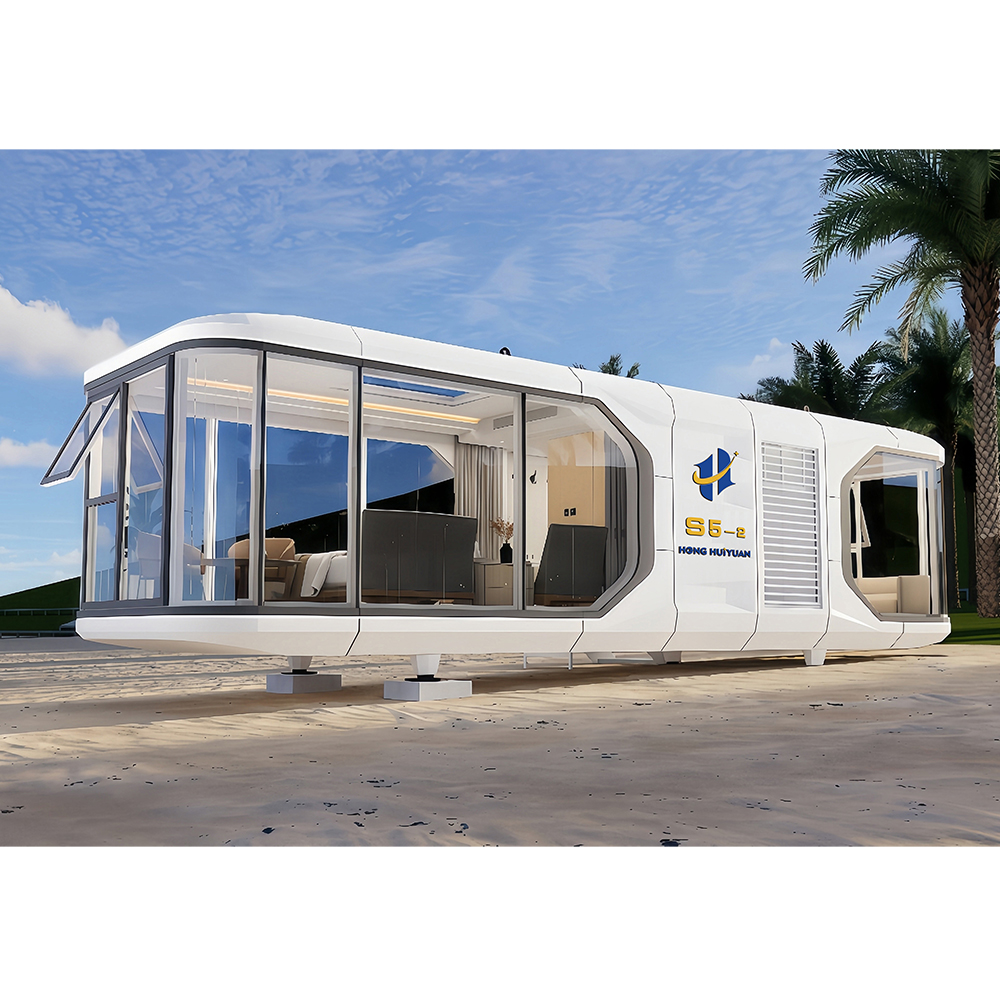 S5-2 Fully Enclosed Space Capsule HouseThis 11.5m by 3.3m capsule house includes a steel frame, polyurethane insulation, smart controls, and off-grid solar and battery options, providing a durable and self-sufficient living solution.View Product →
Yes. The standard off-grid package pairs a 6-10 kW solar array with a 10-20 kWh lithium battery bank. This covers the heat pump, ventilation, and lighting loads in a full 24-hour cycle. For prolonged cloudy periods, a diesel or liquid-fuel backup heater keeps the interior above minimum temperatures without draining the battery.
A single Extreme Climate Habitat Pod arrives as a factory-complete module. Anchor the base, crane-lift and level it, then connect the electrical and water lines. Most installations are live within one to three days, because all internal wiring, plumbing, and HVAC work is done before shipment.
With the 120 mm polyurethane envelope, thermal breaks, and triple-glazed windows, the standard extreme package holds a 22°C interior from -40°C exterior to +50°C exterior. For sites outside that window, the engineering team adds insulation, glazing, or a larger heat pump.
Begin with the coldest or hottest average month, plus the prevailing wind and dust conditions. The supplier engineers compare those figures against the pod U-value and HVAC sizing to confirm the required insulation layer. Submit a site description through the product enquiry form to receive the calculation.

 Contact Us
+86-137 5820 5685
+86-571 8550 0659
 Send An E-mail
Building 4, No. 2, Shuyun Road, Yuhang District, Hangzhou City, Zhejiang Province, China
 Mobile

 English
 Español
 عربى
عربى