2026.04.30
Content
Modular homes are factory-built residences constructed in discrete three-dimensional sections—called modules—then transported to a prepared site and assembled on a permanent foundation. Each module arrives essentially complete: framing, insulation, wiring, plumbing, interior finishes, and windows are all installed under controlled factory conditions before the unit ever leaves the production floor. On site, a crane sets the modules onto the foundation, a crew joins them together, and finish work connects the mechanical systems across module seams.
This is fundamentally different from manufactured housing (still commonly called mobile homes), which is built to HUD federal standards and sits on a steel chassis. Modular homes are built to the same International Residential Code (IRC) or local building code as any site-built house, are inspected by state or local authorities, and are legally treated as real property once placed on a permanent foundation. They appreciate in value, qualify for conventional mortgage financing, and are indistinguishable from site-built construction to an appraiser or future buyer.
The prefab label is broader and sometimes used interchangeably with modular, though technically it encompasses panelized construction (flat wall panels shipped to site), pre-cut systems, and container homes as well. In common usage, modular prefab homes refers to the module-based factory-built category—the type with the most developed supply chain, the widest range of floor plans, and the clearest regulatory pathway in most U.S. states and many international markets.
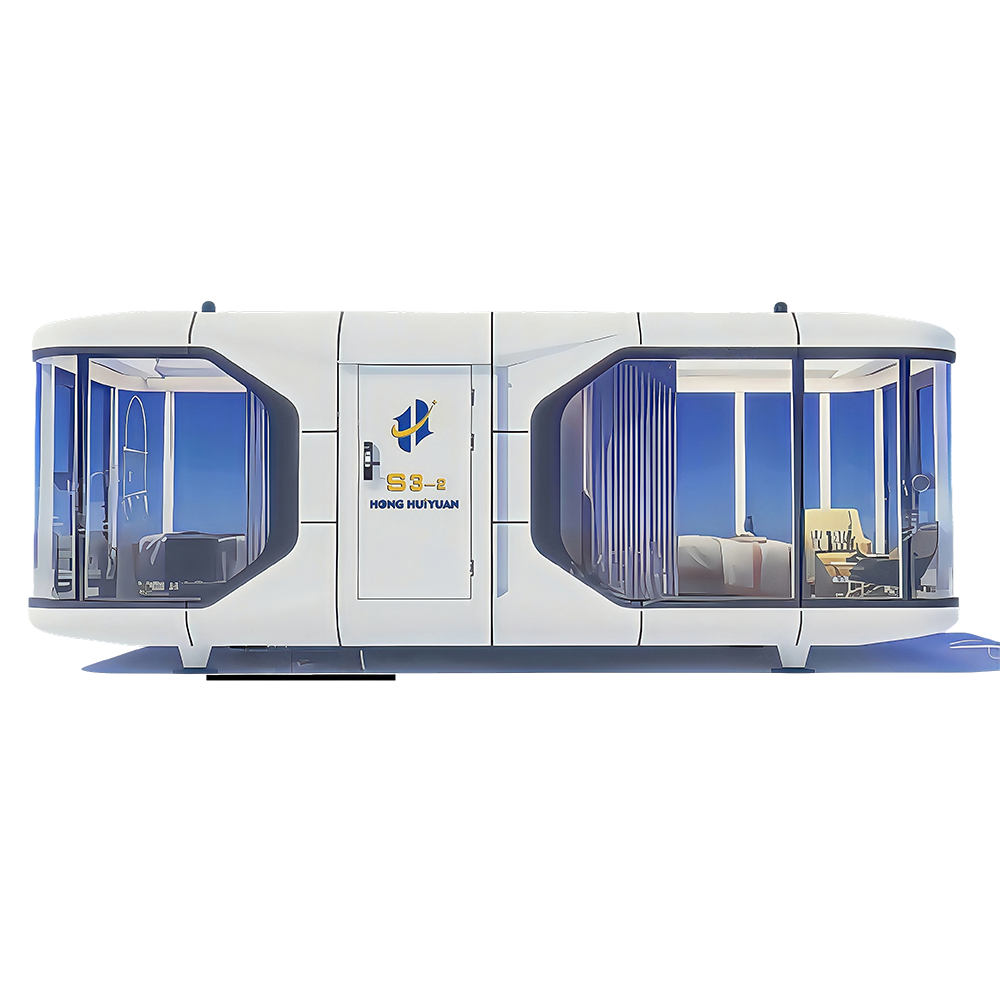
Small modular homes—generally defined as units under 1,000 square feet for a single module or under 1,500 square feet for a two-module configuration—have seen the sharpest growth in interest within the broader modular category. Several converging factors explain this.
Land costs in high-demand areas have made large home footprints economically impractical for many buyers. A 600–900 sq ft modular home on a compact infill lot, accessory dwelling unit (ADU) footprint, or rural parcel achieves owner-occupied housing at a total project cost that a full-size home on the same land cannot. For buyers prioritizing financial independence over square footage—a demographic that spans retirees downsizing, first-time buyers, and remote workers relocating from expensive metros—the small modular format delivers a permanent, code-compliant, mortgageable residence at accessible cost.
ADU applications are driving a significant share of small modular home placements. In states like California, Oregon, Washington, and Massachusetts, ADU regulations have relaxed substantially, making it legal to place a second dwelling on a single-family lot. A small modular home set on a prepared foundation in a backyard can serve as rental income, multi-generational housing, or a caregiver suite—purposes that are difficult to achieve with site-built construction at comparable speed and cost.
Vacation and recreational properties are another strong use case. A single-module home in the 400–800 sq ft range placed on a rural or lakefront lot provides a permanent, insulated, fully serviced cabin at a fraction of the cost of comparable site-built construction in remote locations where contractor availability and material logistics drive prices upward.
Modular home pricing is consistently misunderstood because manufacturers quote base module prices that represent only a portion of the total project cost. Understanding what is and is not included in each price tier prevents budget shortfalls that derail projects after the order is placed.
Factory pricing for modular homes typically runs from $80–$160 per square foot for standard configurations and $150–$250 per square foot for architect-designed or custom modular products. A 900 sq ft small modular home from a production builder might carry a base module price of $90,000–$130,000. This figure covers the factory-built structure delivered to a site within the manufacturer's transport range, usually 200–500 miles.
Site preparation and foundation are entirely separate from the module price and vary enormously by location and site conditions. A straightforward crawl space foundation on level ground in a low-cost market might run $15,000–$25,000; a full basement, sloped site, or expansive soil condition can push foundation costs to $50,000 or more. Site work including clearing, grading, access road, and utility connections adds further. For most small modular home projects, site costs represent 30–50% of total project cost—a figure that surprises buyers who focus exclusively on the module price.
After the crane sets the modules, a general contractor or the manufacturer's installation crew completes the marriage wall (the interior joint between modules), installs exterior finishing at seams, connects plumbing and electrical across modules, and completes any items deferred for site installation such as porches, garages, and HVAC equipment. These costs typically run $15,000–$40,000 depending on home size and complexity. A realistic total installed cost for a 900 sq ft small modular home on a prepared site in most U.S. markets falls between $180,000 and $280,000—still substantially below median site-built construction costs in most metropolitan markets.
| Cost Component | Typical Range (900 sq ft) | Notes |
|---|---|---|
| Factory module(s) | $90,000–$145,000 | Includes delivery within transport range |
| Foundation | $15,000–$50,000 | Wide range by site conditions |
| Site work and utilities | $10,000–$35,000 | Clearing, grading, well/septic if rural |
| Set, finish, and connections | $15,000–$40,000 | Marriage wall, seam finish, HVAC hookup |
| Permits and inspections | $2,000–$8,000 | Varies significantly by jurisdiction |
The practical differences between modular prefab homes and site-built construction are more nuanced than most comparison articles suggest. Neither approach is categorically superior—each has genuine advantages in specific contexts.
Factory production and site preparation happen in parallel—while the modules are being built, the foundation is being poured. Total project timelines from order to move-in typically run 4–7 months for modular construction versus 10–16 months for comparable site-built homes in most markets. Weather delays, which account for a significant share of site-built overruns, do not affect factory production. For buyers facing time constraints—a lease ending, a relocation deadline, or the need to generate rental income quickly—this timeline compression is a concrete advantage.
Factory construction eliminates weather exposure during framing—a meaningful quality factor since lumber that gets wet and dries repeatedly before sheathing is installed develops higher moisture content and increased susceptibility to mold and shrinkage. Factory workers perform the same tasks repeatedly on a production line, developing proficiency that intermittent site-based labor does not. Independent structural testing has found modular construction to be as strong as or stronger than site-built equivalents in part because modules must survive transportation loads that exceed normal wind and seismic forces, prompting manufacturers to over-engineer connections relative to minimum code requirements.
Modular construction involves genuine design constraints that site-built construction does not. Module width is limited by transportation regulations—most states allow a maximum of 16 feet without a special oversize permit, making 14–16 feet the standard module width. Very open floor plans with long uninterrupted spans are more difficult to achieve across module joints than within a single large site-built framing bay. Steep or highly irregular roof forms add cost and complexity. Buyers seeking highly customized architecture typically find custom or semi-custom modular builders, which work from proprietary design systems, more accommodating than production-line manufacturers—at correspondingly higher cost.
Modular homes on permanent foundations qualify for conventional mortgages (Fannie Mae, Freddie Mac), FHA, VA, and USDA loans—the same financing available to site-built homes. The complication is that modular construction requires a construction loan that converts to a permanent mortgage upon completion (a construction-to-permanent loan), since the home does not exist as collateral until the modules are set and the certificate of occupancy is issued. Lenders experienced with modular construction handle this routinely; buyers who approach lenders unfamiliar with modular may encounter unnecessary friction or incorrect loan denials based on confusion with manufactured housing, which has different financing treatment.
The manufacturer selection decision carries more long-term consequence in modular construction than the equivalent contractor selection in site-built projects, because the manufacturer controls a larger share of the final product. Several evaluation criteria deserve more attention than they typically receive in the buying process.

 Contact Us
+86-137 5820 5685
+86-571 8550 0659
 Send An E-mail
Building 4, No. 2, Shuyun Road, Yuhang District, Hangzhou City, Zhejiang Province, China
 Mobile

 English
 Español
 عربى
عربى